Wednesday, February 23, 2011

Walk this way...

rooftops of Antwerp

Antwerp differed from our other stops in that we had no plan, didn't go to a single museum or Place of Great Historical Significance. Also we weren't even really sure what the local language was. Flemish? Dutch? French? An amalgam of all of the above? Strangely, this didn't really bother us too much. Everyone spoke English anyway. Convenient.


We'd figured out that Jupiler (not Jupiter, as we'd initially thought it was called) was the beer of choice, located an Irish Pub within half an hour of setting foot in the city, and our hotel room at the Radison Blu was elegantly modern and close to the railway station.


which is stunning, a tourist attraction in it's own right. had we a guidebook we would have known that you can tour the rooftop...but we didn't. Ah well.

We also didn't go to the nearby and famous Antwerp Zoo, one of the oldest in the world,


camel!

nor did we search out anything to do with diamonds, even though Antwerp is the mothership. Some 70% of the worlds polished diamonds are traded there. Eh, diamonds schmimonds.


Instead of doing what we might have done had we been in possession of a guidebook, we first figured out the local train system. After spying it on a map we (OK, I) just had to hunt down Elisabeth Station. It's spelled the same way as Bethy's full first name, you see, therefore I needed a cheesy photo.


There. Perfect souvenir. We walked around on streets like these and didn't worry about what time it was or getting lost or anything else.


Grote Markt, the central square of Antwerp was an obvious direction for even the most oblivious tourist, so we trotted obediently in that direction, following the bells of the Cathedral of our Lady.

We decided on principle against paying to enter the cathedral proper,

which may or may not have been worth the entry fee as it is very grand indeed, as you can see from the door.

Later in the day we paused at the doorway again to listen to a violinist playing a nearly flawless and very fast Bach's violin concerto in E major. This particular piece happens to be my personal nemesis. Mike recognised it instantly even though I haven't tortured him or myself with practicing it for a good ten years. This is no reason not to enjoy someone else playing it.


There was no charge to go into the gift shop, (go figure!) so we went in there and peeked around to see the sanctuary. It was fortunate we did this; had we not we would have missed what we irreverently christened "Holy Rollers" for sale:


These six-sided pieces of wood have a different grace on each side, available in the language of your choice. I think they would be great for kids...roll the dice and say yer grace, children.


The Grote Markt,

where cars are forbidden, is a marvelous place to walk around and admire the Flemish renaissance architecture, such as the 16th century city hall:
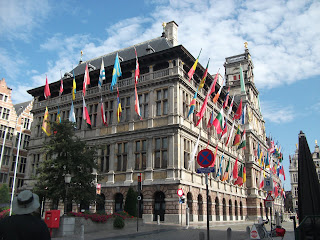


Many of the buildings were crowned with multiple gold statues, and the cathedral soars above them all. We watched a wedding party gather, including little flowergirls in their darling, overpoweringly frilly white dresses in front of the Brabo Fountain which stands in the middle of the square.

Now, this fountain depicts a man holding a large severed hand aloft with water flowing intermittently out of the chopped end. Tasty.


Antwerp is a port city and in days of old, the legend tells, a nasty giant charged high tolls to the sailing crews wishing to enter the city. If the sailors couldn't pay the giant, in a very giantish way, took the sailors' hands as payment. Not terribly friendly, and an interesting take on the arm-and-a-leg pricetag.

Fortunately for the sailors, a hero named Brabo took things into his own hands (sorry, couldn't help myself) and vanquished the giant by whacking off his head and in a tit-for-tat move, one of the monster's hands. The statue shows Brabo flinging the severed limb into the Scheldt River, freeing Antwerp to become a major trading center.

Nowadays you can buy a nice giant's hand made out of Belgian chocolate as a souvenir to bring home to the grandkids. Can't you just see the t-shirts? "My grandma loves me and went to Antwerp and all I got was this lousy severed hand."

Actually, depending on the kid, that might be pretty cool.

We heard a clop-clop-clop sound and turned to see a tall carriage drawn by honest-to-goodness Belgian draft horses. It's entirely possible I went a little cuckoo with the camera.


There wasn't even a line to ride, so we climbed happily up to the seats, plopping ourselves down onto buttery leather seats. The team stood patiently, patted and cossetted by small children until the dour-faced, white haired, hatted driver reappeared and with gruff sounds and hand gestures shooed them away, a flock of disappointed little birds.


He may have been cranky to children but, not speaking a word, he gave us each beer coupons after we paid a reasonable amount for the tickets. Taking the reins, he clucked to the horses, and they began to pull us easily along a route they'd obviously traversed before.

If you ever get the chance to ride in a carriage I would highly recommend taking it. People's faces lit up as they smiled and some even laughed delightedly at the sight of the team pulling a carriage over cobblestone streets. We were like rock stars, swaying gently back and forth high above the adoring crowds that gathered to watch and photograph us.


There is something terribly romantic about travelling through a city as someone might have hundreds of years ago. Not only was it a wonderful way to see the area, it was also made it easy to plan where we would explore on foot later.


Antwerp is very, very European, not postcard perfect but darned close, and so unpretentious it takes no effort whatsoever to relax at a streetside table enjoying the view and people watching as you also enjoy a beer and a thick slice of meatloaf smothered in saucy cherries with tiny potatoes.

At least, that's what I did. Also highly recommended.

I'll leave you with this bit of graffiti, one I found funny only because it was next to the "Omlegging" sign, which I believe translates to 'detour.'

Isn't that the perfect Dutch-esque name for that fellow?

Monday, February 14, 2011

A crazy little thing called love..

It was a little crazy, deciding on the spur of the moment where we were going to go.


graffiti, Antwerp
I mean, we were in foreign lands, not even able to speak the language. I suppose some might even consider us foolish to not have decided where we were going, reserved our train tickets, and carefully researched the options ahead of time. We had picked the brains of some of our better-traveled European friends as to where we should or should not go, but that was pretty much it.

In the moment, it was rather freeing. Mostly we went for what was convenient. There are worse decision-making techniques being employed out there, right?

And you know what? It worked out fine. Better than fine, actually. The train personnel are multilingual and impressively competent in getting you to where you sporatically decide to go (!), and with the internet it was a simple matter of a few keystrokes to find a hotel room.

All we had to do was book it to the train, which turned out to be so long that we were positively gasping by the time we came to the end of a serious foot-pounding heart thumping hustle to our assigned carriage. Hurled ourselves inside and watched Paris roll away.

Antwerp-bound.

I didn't have a color-tabbed guidebook now. Heck, I had no guidebook, no printouts, not even a lousy brochure.

Awesome.


Now, Antwerp has an entirely different feel the moment you step off the train. If Paris is an eclair, then Antwerp is a waffle. Not as serious about itself, nor as decadent or elegant but playful, a little kooky, even.
I remember walking onto campus at university and having a certain sensation, a feeling that we all recognize but there isn't a name for. It's a combination of feeling that the world and life and all their riches are open to you, with a sort of dark undertone that you know they actually aren't, which expresses itself as irony, then gleefully topped with the powdered sugar that is a giddy devil-may-care silliness and a willingness in spite of yourself to try things, to accept the unusual, to see in other ways. It makes you walk rather than drive, talk about deep things and not-so-deep things, crack jokes, linger over drink and conversation, and learn.
Maybe it's just me.
Anyway, that's how Antwerp made me feel. Like a university student in my 20s in the summer sun.
In Antwerp, there is chocolate, (Belgian chocolate!) and there is beer (Belgian beer!), and there is plenty of that incredible coffee for discussions.


This could be heaven. Not a quiet heaven, but a lively, fun one. Cherubs instead of angels and cobblestone lanes to wander

with that outdoorsy, healthy feeling that is unique to certain European cities.


It felt...like a place to be in love. How funny is that? We'd just left Paris, which is supposed to be the place to get all gaga and romantic, and we appreciated it, sure, but Antwerp is such an unexpected little gem, a last fling for us before returning to the USA, parenting and bills and jobs and all the everyday things that we, well, have to remind ourselves to appreciate. I suppose it was inevitable to feel a bit goofy.

Which may be why I laughed myself sick over this SUPER SNEL service sign (can't you just hear Colonel Klink shouting it at poor bumbling Schultz?) and then went to find myself and my spousal unit some more lovely beers.
Seemed like the thing to do.

Monday, February 7, 2011

Adieu l'Émile je t'aimais bien

Hauntingly beautiful grave, Cimetière du Montparnasse

We had one unplanned day, unplanned in that we hadn't decided where to be. We could stay in Paris, get on a train to Belgium, either Ghent or Brussels or Antwerp, or go straight back to Amsterdam to get in one more day there. Pretty much Paris-ed out, (nothing against Paris or the Parisians, here, mostly just tired of being two in a sea of tourists) looking at train schedules, we elected to putter around half a day more in Paris, and then à bientôt to France and off to Belgium.

Over breakfast Mike and I flipped through my well-tabbed Lonely Planet guide book to figure out what to do with our last hours in the City of Light.


Ironically, breakfast, like every meal I've had here, was not what I would call light cuisine. Waist-wise, it was a good thing the trip was nearly over. The jeans were getting tight. That salad, however one might wish it to, does not balance out the cheesy goodness and cholesterol. Again, jet fuel espresso, God bless it, was the only way to restart our hearts and get us out the door.

I had carefully color tabbed the pages of the guidebook, which was bristling with them.

Blue tab meant that's interesting. Green was sounds like a tasty place to eat. Yellow meant it could happen. Orange was it would be great if we got to do this. Bright pink tabs screamed DO IT or DIE.

All the bright pinks were done. So we moved on to the oranges, and looked for something maybe a little different. The catacombes fit that bill and would be...interesting. There is a series of tunnels beneath the city, and the catacombes are the portion that has been turned into an underground ossuary. The cold walls are lined with carefully arranged skulls and other bones from the days when the city's cemeteries were mass graves, overfilled with the dead...no, you really wouldn't want to drink the groundwater in those days.

Morbid and definitely memorable.


So we went hustled out there on Paris' fantastic Metro, off at the Denfert-Rochereau station, and were greeted by our least favorite thing: the sight of a line that literally went all the way around the block. Seriously? All those people were willing to spend a good amount of a beautiful day in Paris to go down cramped, cold staircases through dark claustrophobic passages under the ground, full of bones and slippery from dripping water?

Well, we weren't willing to stand around. Nicely, I had my little tabbed guidebook, and one orange tab and a few blocks away was the Cimetière du Montparnasse, Montparnasse Cemetery, where rich or distinguished personages from were not stacked like cordwood or tossed into big slimy pits, to say the least. This was a classy sort of neighborhood to end up in.


Heroes from the wars, intellectuals, artists, political leaders, scientists and adventurers are all found here beneath grave markers that range from classic to modern, elegant, elaborate, whimsical to sentimental. With all the sculptures, memorials and serene parklike setting it was a beautiful place to walk. I hear folks even come to picnic on the extensive grounds. Practical.


My favorite tomb would have to be that of Charles Pigeon, the inventor of the Pigeon gas lamp:


Immortalised in a life-sized bronze sculpture, with a pencil and notebook in his hand, he is forever in bed next to his wife, an angel watching from the headboard above them.

Giving a full report here, (you can always count on me!) I discovered one of the most primitive bathrooms I have ever been in, which is saying quite a bit as the bar is set pretty low on that score. It was amazing I got out of there neither wet nor soiled. All the glamour is allotted to the deceased, not wasted on the living.

We walked and walked, stumbling across the graves of such notables as the intellectual partners in political activism, polyamorism, existentialism, Jean-Paul Sartre and Simone de Beauvoir. (Feel free to add your own -isms to the description, there. I know you can come up with some.)


Tourists had left train ticket stubs and lipstick kisses on this grave, which shows how well those tourists read their guide books. The metro tickets are actually supposed to be left on Serge Gainsbourg's grave in honor of his song "Le Poinçonneur des Lilas," a dark little number about a man in the monotonous and somewhat meaningless job of punching holes in Metro passenger tickets. As he works he fantasises about putting another hole in his head, and then of being placed in his eternal hole in the ground.


Back to today, the misplaced lipstick kisses were supposed to go upon Oscar Wilde's grave, which is in Cimetière du Père-Lachaise (yes, an entirely different cemetery), but I suppose de Bouvier and Sartre would have appreciated the irony and Oscar Wilde certainly would have had a chuckle over it.

The cemetery, in all, is a sort of marvelous outdoor historical museum, full of art and life appreciation moments, and not at all a bad way to spend a morning.

There were a few more wonderfully Parisian moments I have to throw out there:

statue among the lighting and sound setup for a concert


the fantastic Art Deco signage for the Metro

an American musician on the Metro.

Did you know the musicians are held to a certain musical standard and must acquire a license before they may perform on the trains or platform? I approve!

Second menu item down, translated for us as a "piece of the butcher."

Yikes, better wield that cleaver more carefully next time. (I'm kidding, I'm sure it's something much more mundane like a special of the day.)


and what appeared to me to be a perfect moment in Paris,

reading quietly in the midst of the city.

At Paris Nord we boarded what was by then, emphatically not counting the Paris Metro, the 10th train of our trip, this time headed for, what the heck, Antwerp.

Monday, January 31, 2011

Je vois la vie en rose...

With the victory of Notre Dame (the cathedral, darn it, not the football team!) firmly under our belts and soaring in our minds, there was only one thing to do. I mean, besides eat and have more coffee and more wine. (Those are a given.) The thing to do was to take a train out to Versailles Palace.

Now, having lived in Dubai, which is nothing if not conspicuously indulgent in many, many ways, and having been to the Dolmabahçe Palace of Istanbul, the attempt by the sultan of the time to make Turkey appear opulent (unfortunately for the plan, it cost so much it almost completely bankrupted the country) we figured we're pretty well immune to such things. I mean, how gilded and over-the-top could a palace be?

Let me tell you.

Louis XIV took a hunting lodge and in a political masterstroke had it transformed into a palace fit for a god, the Sun God, actually. A place where he could rule supreme, forcing the nobles of Paris and the rest of France (and the world for that matter) to have to come to him on his terms if they wished to receive his favor. He strikes me as a man who desired to be nothing more than the most powerful king of the most powerful country in the world. Obviously such a king would not only need but was also entitled to the most magnificent palace in the world.

As the longest reigning European monarch in history, (72 years to Elizabeth II's current 58, if you're keeping score, but she still has the larger castle, good for her), Louis XIV the Sun King, had plenty of time to make his palace in his image, and he did a knockout job.

So here came Mike and me on the train, along with the millions of others each year who visit the palace that housed Louis XIV, Louis XV, and Louis XVI, and then finally that little man with a particularly big opinion of himself, Napoleon. The train spit us out into the village of Versailles and it was with no difficulty that we found Versailles Palace itself.

Which, even when employing the panoramic option on one's camera, can't be fitted into one frame.

Just as big as you might expect, living up to the hype and legend, this palace consists of 700 rooms, surrounded by another 1800 acres or so of gardens. The line to get into the palace was proportional, seeming acres of people standing single file in line, a rope-defined maze of straights, corners, and boredom. Mike manned up in a highly generous gesture, asserting that he would have less interest in the gardens than I, and volunteered to wait in that very, very long line. I agreed, only half reluctantly, that we should conquer by dividing our resources, and feeling less guilt than I probably should, went out to the gardens, which are, incredibly, free to the public.


If you like topiaries, symmetry, and statuary, then the gardens of Versailles are for you, my friend. I cannot fathom the army of gardeners that it must require to keep up this level of perfection. Yet we never saw so much as one with a pair of clippers.

I suspect some sort of French magic is employed there to make it work.

Awestruck, I noted that not only are there the topiaries and brilliantly blooming beds of flowers, there are also beautiful urns and statues every few feet, aesthetically placed for the greatest impact, and each one is different. I could easily have spent an hour just photographing details from the urns.


But I had promised to hurry, and I tried, I really did. I honestly only went through the closest part of the garden, and I only took shots of my very favorite statues and scenes. Even so, breathless and overwhelmed, by the time I'd dashed back to where Mike had been waiting he'd was already inside purchasing our tickets. I had wondered about the folks who forked out 30 Euros per hour for golf cart rental to drive around the grounds, but I think that it might be a real necessity for true garden lovers. Or several days to explore and sketch and marvel. And good shoes.


I decided I would have to make sure Mike got out to the gardens, but for now we entered the palace itself.

What a place. The best word to describe it would have to be spectacular.


With honorable mentions to overdone, ridiculous, amazing, and holy guacamole.

While I'm not sure I should approve of the excess, especially at the cost (Louis XVI and Marie Antoinette's heads 100 years later, for instance), if you're going to go the distance, I suppose you had better do it shamelessly. I couldn't help but be pleased that so many artisians were employed to make it happen so many years ago. Gilt, crystal, velvet, marble, artwork, every surface covered with richness. By the time we'd reached the awe-inspiring Royal Chapel, Mike leaned towards me and whispered, this makes Dolmabahçe look like a trailer park.

He was right.

Even with its vast interior, Versailles was crowded, of course, and I was shocked more than once to see tourists actually touching the paintings. Crowd control there must be a nightmare. Just because there were rooms where there were mere inches between the frames, so covered were the walls with portraits of important persons and beloved pets didn't mean they weren't still valuable and irreplaceable pieces.

Much of the brushwork was fortunately beyond reach, above our heads as vividly painted ceilings, and everywhere were motifs of sun and fleur de lys and cockerel. The Hall of Mirrors (Grande Galerie or Galerie des Glaces), is rightly one of the most famous rooms in the world.


Mirrors were a true luxury in their day, and the room, designed to showcase such wealth, is stunning, especially in a historical sense. It was there that Louis XV met his future mistress, the Madame de Pompadour during a masked ball, (ironically, to celebrate his marriage) during which she daringly dressed as Diana, the Goddess of the Hunt.

And they say Hollywood has run out of tales to tell.

William I was declared Emperor of Germany in the Hall of Mirrors in 1871, and to really annoy the Germans and rub their noses in it for losing WWI, the French Prime Minister insisted the Treaty of Versailles be signed there in 1919. Today it is still used for State occasions.

I'd rather like an invitation to one of those.

Goodness, what would one wear?

I probably don't need to worry about it.

If you ever want to get a real insight into the thinking of the time, you must look up Louis XIV's Lever , the extremely elaborate ceremony of the king's waking in his bedchamber. Un-be-lievable. From being kissed every morning by his nurse to allowing only the most privileged nobles to address his majesty before he began to dress, (lesser favored nobles might see him whilst he dressed, which was quite the crowd, and then other courtiers would have to wait until he actually got up and left the bedchamber.) Benjamin Frankin, for instance, was personally received in the bedchamber, (France looking for ways to undermine England any way she could) which ended up being a good thing for the Colonies and not such a good thing for the coffers of France, but that's another story.

Either way, here is one of the Royal Beds, one of the rare pieces of furniture still left in Versailles.


Most of the original bits were carted away by the poorer and rather rebellious French commoners whenever the political winds blew that way. We were assured that the curators are doing their best to try and get some of it back.

We wish them luck with that one.

The Hall of Battles was another impressive area, stretching along, enormous paintings depicting the tales of French victories


(yes, there are French victories in battle, all joking aside, now!) next to the Coronation Room which I believe was bombed in 1978 by radical Breton separatists (they don't talk about that on the audio guide) a room devoted to artwork from Napoleon Bonaparte's time.

Napoleon was not only one heck of a military man, he also, we learned, employed artists to paint people in or out of paintings depicting scenes of historical importance should they have changed status in his favor. Therefore his mother ended up being a guest at his coronation after all, and I seem to recall that Empress Josephine was painted out of another painting after their divorce.


The Coronation of Empress Josephine. She got to stay in this one.

Being a god but short and with bad teeth must have made Napoleon a bit cranky, some days. Fair enough.

We were happy enough being mere mortals, walking the marble corridors of history.

Though we were fatigued by so much grandness, I insisted Mike must follow me outside to see the gardens, and to admire the palace from that side,


which he agreed was time well spent.


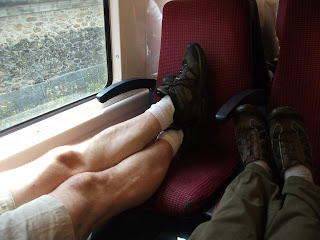
We couldn't bring ourselves to go chasing down Marie-Antoinette's estate, preferring instead to settle back onto the train with our feet up for the 40 minute ride back to Paris.


We ended up near the Paris Opera house, with a nod to the Phantom.


It really is glamorous, and a good place to watch the visitors and residents of Paris. I can only assume it is quite good for opera lovers as well.


The evening upon us, we drifted tiredly back toward the Arc de Triomphe and our hotel, and found, on the little side street Rue de Surène, a softly glowing and simply modern restaurant that appealed called Le Taste Monde.


Finally, on our last evening in Paris, a meal for the Gods. With exquisite service and an emphasis on wine, little English spoken, but what did that matter in the language of food, we had a simple but memorable evening. Mike even had Ratatouille for one of his courses, which pleased our Pixar movie lovin' children no end when they heard about it.

A perfect ending to the day.