
Unlike pilgrims of times past, Mike and I braved neither quicksands nor tides to journey to Mont-St-Michel. But we did have to endure the reportedly perennial flood of tourists.

through the portcullis and into the throng

Of which we were part, so one can't really complain. Like all magical places, everyone wants a little piece of it. The narrow streets of Mont-St-Michel during the day are so ridiculously packed we didn't want to fight through them with our luggage looking for our hotel. Therefore the first thing I did was to go to the information center.
I was looking over the maps and couldn't find one in English. The information clerk looked over the desk at me and said something in French that I didn't catch. I sort of stuttered at him (French speakers look away now) une carte de Anglais s'il vous plait?
He looked at me passively for a good 10 seconds and then answered, "I'm not sure what it is you just said, but I think what you want is a map in English."
He handed me one from a pile behind the desk. I scuttled away.
Mike, waiting outside with the backpacks, laughed himself sick.
I needed to be laughed at one more time like I need a hole in the head, but as you know, those moments are the ones that make travel a great time to learn things about yourself.
Speaking of holes in the head, let me tell you how Mont-St-Michel came to be.
According to legend, in the year 708, St Aubert the Bishop of Avranches was visited by the Archangel Michael three times. On each occasion Aubert was instructed by his heavenly visitor to build a church on the rocky island then known as Mont Tombe. You remember the quicksands and tides...this was a daunting task to say the least, so Aubert ignored St Michael.
The Archangel, apparently not appreciating being taken lightly, and not the gentlest member of the holy host, burned a hole in Bishop Aubert's skull with his finger.
This was convincing. St. Michael got his church, and pretty darned quick, too.
Fast forward back to us, 1300 years later. The Auberge Saint-Pierre Hotel receptionist gave us a choice as to how she would lead us to our room...the way with fewest stairs but quite crowded, or the long way with many stairs and not too many people. We went for the latter, with the obvious approval of our receptionist.
Going up through the village was amazing, and also one heck of a cardiac workout. Up stone stairs, then more, and yes more. The buildings were also stone, with a smattering of wood and metal, all straight out of a fairytale. We went past a tiny cemetery, with aged stones and cascading roses, up staircases with more stonework walls. Truly another world which we couldn't have been more pleased to experience without crowds, the main street left behind.
With burning thighs but glad hearts we entered our room through a discrete doorway -the hotel rooms were not in a central location but dispersed around the island, and it was anyone's guess as to which one we would get. Ours was splendid. With a view over the water and salt marshes, through windows that were straight out of Snow White, and above, heavy dark beams in a creamy high cupola ceiling, our own little nest in a medieval town. Happy campers.

There was also a bit of smugness involved. You see, while 2 million people visit Mont-St-Michel each year, only those who are staying overnight may remain on the island after dark. We'd made a good decision staying on the island in another way; the hotels on the other side of the causeway were, if one looks over the online reviews, uniformly expensive and hideous. Some folks try to squeeze in Mont-St-Michel as a day trip. I think they miss an awful lot.
Once you've spent the time and currency to get there, as I see it, there's no point in being cheap. You might as well go for the gusto...and to save money in others ways, take your photographs, buy only the occasional postcard as a souvenir, and for heaven's sake, carry a nice bottle of mainland grocery-store purchased wine and a corkscrew in your backpack.

St Joan of Arc
We stopped to watch a famous Mère Poulard omelette being made. A specialty of Mont-St-Michel, these are created by separating eggs, whisking the yolks in a copper bowl and then putting them into a special long-handled pan over the fire with some melted butter. When they start to thicken, egg whites that have been beaten into foamy peaks and some Crème Fraîche are gently added, and then the entire beautiful mess is folded into the fluffiest mass of egg goodness you can imagine. You may then eat this omlette if you are willing to fork over 30 Euros for it. About $40. Makes you appreciate the humble $1.50 street hotdog, doesn't it? The pièce de résistance of our time on the island, though, had to be put off, with great anticipation, until after dark. Finally darkness fell over Mont-St-Michel, and after a last glass of wine, we made sure we had our tickets and climbed up and up through the velvety evening to the Abbey. There were stars, and little bats swooping through the air to capture insects attracted by the floodlights, and the intensely medieval Abbey. The air was fragrant with the ancient scents of sea and rock. Close up, its presence is even more impressive, more enchanting. It felt like a spiritual journey to approach and enter this holy place. Inside the labyrinthine Abbey, I am told you can get rather lost during the day, but at nighttime they have a pathway carefully roped off for visitors. After the church are the cloisters of the monks, In their dining hall, the Benedictines would have dined in silence, perhaps hearing scriptures read. For us, the ghostly room echoed with the amplified and ominous tick-tock of an unseen clock, a reminder of mortality, perhaps. Beyond, Brittany and Normandy spread out below us, divided by the Couesnon River. Soon the paved causeway from the 1800s, which is causing silt and mud to build up around the island and threatening to make Mont-St-Michel part of the mainland, will be replaced by a bridge, so that the tides may once again sweep away the buildup, leaving Mont-St-Michel the fairytale island it should remain. As for Mike and me, it was with regret and a unlooked-for sense of loss that we left the Abbey behind. Hours after we had entered, and well after midnight, we drifted down the stone stairs to our room. I found myself drawn to look back almost irresistibly to the gilded statue of St Michael at the very tip of the Abbey high in the heavens above us. The rest of our time in Mont-St-Michel was again, as if in a dream, and when we watched the tides come in again in the morning, the presence of the Abbey behind us was nearly palpable. Mike had carefully scheduled our entire vacation around the tides so that we would be at Mont-St-Michel at the best possible time, yet somehow the divine power of the Abbey surpassed even the tides in my memories. It was a wonderful revelation to me that the realisation of a childhood dream could, in fact, be even better than I imagined. Being an adult, the gradual loss of childish fancies and beliefs has been a hard, cold, and I thought, inevitable reality. But there are still places beyond the everyday, places like Mont-St-Michel, to be explored and delighted in, that simply transcend the life of one person.
Yes, you read that correctly.
No surprise, those aren't available on the island. There was a gourmet dinner available through the hotel (gourmet in Mont-St-Michel translates to expensive, average-esque French cuisine -which is still relatively good -with less than perfect service). What with the views and the delight of actually being there at Mont-St-Michel, well, we could afford to let it slide this once, and I have to say the chocolate mousse at the end of the meal was exquisite.
As it was, I kept feeling like someone should pinch me to see if it was all real or merely a dream. 
hint of things to come
We wandered and wandered the battlements, the gardens, the towers and fortification walls, ever aware of the majestic Abbey above us as the day ebbed, taillights disappeared across the causeway, the footsteps of day visitors faded and were forgotten, the ancient stone silent.
We found ourselves alone more often than not, as though we had the entire Mont to ourselves. 
 Feeling even more like pilgrims in the dark, we finally came to the abbey. It remained undiminished by our proximity. Sometimes when you get closer to something it becomes more ordinary and accessible. Not the Abbey of Mont-St-Michel. Far from it.
A massive undertaking, the Abbey was built during the 11th-16th centuries, the materials brought laboriously up the rock by means of a giant chain and wheel pulley system Two men would stand inside the wheel, not unlike hamsters, and walk to raise and lower loads. I was rather disappointed that I didn't get a good clear photo of that wheel; Mike standing next to it was dwarfed by it's size and the view down the sheer walls was well worth a swaying moment of vertigo.
The thick stone walls envelop you and you get an idea as to how it was, hundreds of years ago, to be a devout monk here. How easy it must have been to worship God with their hearts and minds, rejoicing in the high spaces and forbidding, mysterious beauty of the place. The path you walk is a masterpiece, combining light and shadows, sound and silence in turn. You come upon musicians in spaces, a piano first, then a flute, a cello, and lastly, in the great apse of the abbey church, a harp whose notes fill the space and are lost an instant later.
You walk almost in a daze, to behold such greatness. 
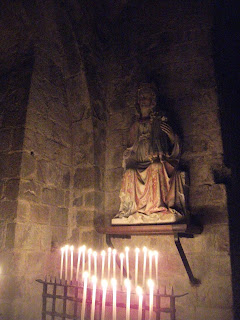 It is not unusual to see tears sliding down cheeks of visitors in the darkness, often unnoticed and unchecked in the darkness.
 My favorite place in the Abbey, even more than the soaring apse of the church, (left) would have to have been the gardens. Framed on all four sides by a arching covered walkway, the monks grew cooking and medicinal herbs there, and you could smell the lavender, even in the black night. Can you imagine how blissful, how rapturous it must have been, so high up in the air, to tend a garden?


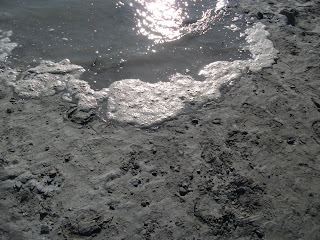 The Gendarmes took to their motorboats, circling rapidly over the turbid tidewaters around Mont-St-Michel, looking for flailing arms or cars foolishly parked outside the safe zones. Apparently a bus had to be tethered once, to keep it from floating away, and when the driver came back he found it a total loss, full of salt water and silt.
  I'll bet that was an interesting conversation between him and his boss.


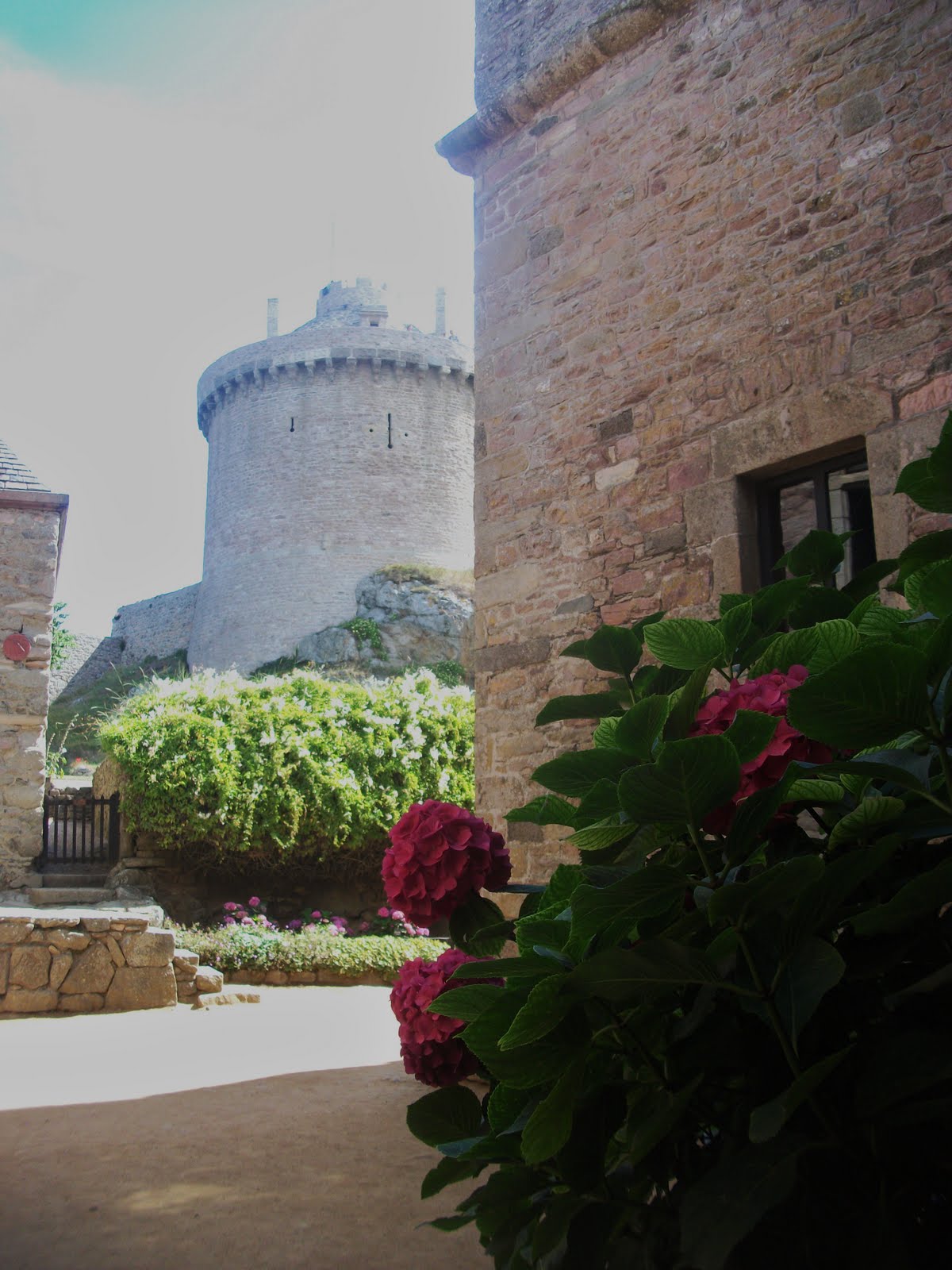

 A fairytale of a place, this is the soul of Bretagne, a place of lighthouses and fishermen, castles and druids and tales of giants from long ago, megaliths, and always the sea.


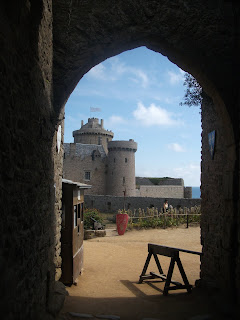
 a grand stone home with impressively large dining hall, (I was thinking you could really go to town and have one heck of Christmas feast there!), canons pointed out to sea, and the oldest part of the castle, the tower itself with its fortifications at each level, which we were allowed to climb and explore to our heart's delight.
 At the very top we looked out over the sea and down from the tower into the knot garden with the warm winds smelling of the sea in our faces and hair.
 Yes, I agree. Tony all the way...with an honorable mention to Kirk. These days sailboats drop anchor in the nearby bay below the castle, and relax in its shadow.
 This is Castle Le Guildo, of the powerful Dinan family, and happily it's being restored. Right now the site is largely ruins, rocks, flowers and lizards. The castle was rebuilt in 1200, 1350, 1487, 1650, abandoned altogether in 1800, but the scaffolding tells me better days are coming once again.


