Monday, December 13, 2010

Hey Brittany...


happy photography accident involving hydrangeas and a raindrop


I promise you,we have come to the end of tearful WWII recollection blogging. If I make you cry again it'll be tears while laughing at the idiotic situations we get ourselves into.


And you know there are plenty of those whenever Americans abroad, and these Americans in particular, are involved.


Two trains from Bayeux, through Rennes, to Guingamp in the Brittany region of northwestern France. While the rest of France is French, Brittany is Celtic. Many of the signs are bilingual, written out in French and Breton or Gallo.


The countryside is wild, with hills and twisting roads and farms dotted with sheep, and fields of poppies and wheat. The charming farmhouses and towns are made of stone, and the hydrangeas, well, they're heavenly.


We came to Brittany for one reason: to relax, as we had correctly thought we might need to, after the emotional WWII tours.


Mike and I were staying in a beautiful, out of the way B&B called Rubertel Chambres d'Hotes, and for a fantastic price. The proprietor showed up for us at the train station perfectly on time in a Jaguar with a right hand side steering wheel. British, you see, and apparently much attached to his car, despite the left hand side driving in France.

He brought us to our new abode, which was serene, to drop off our luggage and then very kindly drove us to the nearby village of Bourbriac so we could get some pizza. An English speaking host and pizza, and not too expensive to boot. This was a good deal for us ignoramuses.

It all went well at first. Heavy wood furniture, chalkboard rife with choices for your pizza and dessert, enough variety of beers, and English speaking expats playing pool as entertainment. In the kitchen the chef was doing some swearing and banging a pot or two, but that added to the ambiance. The waitress and I went a few rounds of my trying to say what I wanted in French and then English and her trying to tell me what I wanted in mostly English, but eventually an understanding was reached.

That is, until the pizzas came to the table. They looked delectable, thin crusted and larger than necessary, but mine, with a wealth of ground beef loaded on it, was entirely raw with the exception of the edges. I mean raw. The meat was red, the crust was still in dough stage. I like my steak pretty rare, but ground beef is another thing entirely.

So I went through another song and dance of getting the attention of the waitress, who was in the process of shoving around the heavy tables to get ready for a large group, and then trying to explain and finally show her the uncooked pizza. She got it, took it away, I heard, quite clearly, an F bomb being dropped in the kitchen, and about 10 minutes later the pizza came back again.

About a third of it was cooked, the middle still nastily cold. I was hungry by this point, and figured, what the hey, I'd eat the cooked part and order one of the lovely looking desserts to fill me up instead of asking a second time for it to be corrected, since no one had come to ask if it was to madame's liking.

Then I asked the waitress for a dessert, to which she gave me a reproachful stare, and made me understand that if one wishes dessert one must ask for it when one orders the main course. Otherwise it cannot be done.

Anyway, the beer and the outer part of the pizza were good, and it wasn't like I was starving to death on this trip, so I let it go.

The friendliest sort of person we met in town was this cat by the Bourbriac Church:


which was fine. It was an awfully friendly cat and told us in no uncertain terms that it wanted to become our pet, American or not. In many ways, I communicated far better with the cat than the waitress, but then, the needs addressed were simpler.


Home again in the Jaguar, and to bed in our spotless room overlooking the garden. In the morning we woke to ridiculously large pastries still warm from the Boulangerie..oh, the agonies of being abroad. Which...the golden croissant or the sweet rolls with apple filling? And tea or dark coffee? And then which of the beautiful homemade jams?


Life can be so difficult sometimes.


The Jaguar being pressed into service one last time, we rode into Guingamp with our agreeable host to rent another car. Walking into a tiny rental place/gas station, I asked the man sitting at the desk if we could rent a car. He looked at me as one might look at the bottom of one's shoe after stepping in something disagreeable and refused to answer. It turned out that he sells petrol; the lady on the phone was the one from whom to rent a car. She, however was very helpful.


We investigated the town, where there was a local farmer's market and a fountain, Notre Dame de Bon Secours Church looking down over all. I will never develop immunity to the allure of the farmer's market, and when it is in a town square of creamy stone and it's French, well...I bought some cherries. And aren't these onions pretty? Makes you want a salad, doesn't it?


We had lunch in a little place open to the postcard perfect town square, though it started to rain so we ate inside where the sulkies (light two-wheeled race carts pulled by a horse) were dashing across the tv screens up on the ochre yellow walls. No surprise, I ordered a salad.


Here I learned something interesting: my salad arrived completely buried beneath an enormous pile of fries and piquant cheese. I had no choice but to have some good red wine to cut the fattiness.


And then a coffee to get me out of my chair.


Those French. They know their wines and coffee. But how do those French women stay so slim?


It's a mystery.


After driving...and driving...and driving up and down countryside roads, through forests and several U-turns, we finally found our B&B again. There I parked the car, giving it a look it didn't deserve (not ITs fault we get so lost!) and resolved not to even look at it until the next day.


Then, on a whim, we begged our hosts to allow us to take their happy bouncy (aren't they all?) Labrador retriever for a little walk. The day was cool and though there were storm clouds on the horizon, it seemed like the perfect thing to do, especially after that lunch.


The yellow lab was agreeable (again, aren't they always?) and our hosts agreed to the walk, joking that they would send out the search and rescue if we weren't back by dark, which was some 3 1/2 hours away, and gave us ideas as to where would be nice for a gentle stroll.


We intended to go the country version of around the block, maybe a mile or two at the very most.


The dog pulling happily at his leash, we passed lovely farms, old farm machinery still in use, old cars,


flocks of sheep, and fields and fields of wheat and poppies.


When we came to a bend in the road I jokingly took a photograph "like Hansel and Gretel to help us find our way back."


When we reached the village of Saint-Adrien to the east with its marvelously old steepled church, 5 km away, we had gone far further than we intended. No worries, we could simply continue turning right as we'd been doing and we'd be home in plenty of time for the several course dinner we'd arranged with the lady of the household.


Right?


Wrong. Wrong, wrong, wrong. Turning right does not ensure you will get back to where you started unless the roads are on a grid system. Dogs came out and barked at us, Frenchwomen came out and barked at the dogs, dragging them away. I was clutching a stick and some rocks in the vain hope that I could Ninja off the dogs should they try to attack our host's pup. The sky grew darker and more ominous, we were tramping up roads, all of which looked familiar but didn't turn out to be correct. Then we left even the fields and farmhouses behind and were were tromping through some sort of woods, where in the blue blazes were we?


I was apologising profusely at regular intervals for coming up with the idea, Mike was steaming at being lost, though not at me (he is such a forgiving fellow sometime) and both of us were fretting about what was going to happen when our hosts realised we had wandered off with their dog...and didn't seem to be coming back.


If only we'd known how to say nous sommes perdus et ce n'est même pas notre chien: we are lost...and this isn't even our dog.


When we reached a hillside overlooking the village to the west, Bourbriac, even I wasn't happy. Seriously, were we being punk'd here? Were there hidden cameras?


Well, at least we'd be able to call our hosts and let them know we were on our way from the pizza place. Mike sat down on one of the rough hewn benches outside on the porch and I went in to get water for the dog and ask if I could look up the phone number for the B&B. The waitress gave us water in a bowl, but then the chef ala F bomb, who turned out to be the owner, came out. I figured we were in good with him. We were his customers from the night before, and even better, he'd spent time in Dubai and would know well the expat code of helping folks abroad.


Wrong again.


Apparently he forgot the code. He went off on a really pissy and very French tirade. He would help us, but not if we weren't going to buy anything, he had to make a living, he is a businessman and we come onto his property and put our feet up (Mike hastily removed his tired feet from the bench in front of him) and and and...


aaannd we left.


At this point we had been walking for hours. The sun was settling on the horizon, and though the dog was still bouncing along, not really a reliable indicator with a laborador, we were beat, and stressing out over the possibility of being late to the dinner being prepared especially for us.


You remember how we had driven around the wrong way several times to find our way back with the car? What this means is that now everything looked familiar. In a car that can be frustrating. On foot, after miles and miles of walking and being treated poorly by raw pizza pissy man, well, it was exhausting.


When we though we were close enough and were at a critical junction, we split up to cover more ground. I ran up a hill...a long, long hill, and Mike went the other way with the still happy if not-quite-as-perky dog.


I had visions of finding the place and returning in triumph. Nothing doing.


Finally we went down a road that felt kind of right...and there was a man out gardening. I asked him for help, and there must have been something in my voice, because despite my speaking English and even worse attempts at French which should have earned me a major brush-off, he motioned for us to wait and got a younger member of his household, a young man whose very good English was exceeded only by his willingness to help.


He pointed us up the road in the right direction. Then, perhaps 2 minutes later, here came the now-familiar shape of the Jaguar with the steering wheel on the wrong side, slowly rolling along the dusty road, looking for us.

With less protesting than we might usually have offered, we accepted a ride (on behalf of the dog) for the last 1/4 mile.

Mike and I dragged ourselves back up the stairway to our room, and while I showered off the worst of the "relaxing" walk Mike graphed out our route on his laptop. We went 11 miles.

Not exactly the walk around the block we'd been trying for.

The meal was beautiful, our hosts gracious and forgiving, had a good laugh at us, but I nearly fell asleep in the beginning course of smoked salmon and shrimp, and neither of us did that dinner justice. Sad.

The next morning the Lab was jumping up and down again. I guess he wanted another walk.

But our hosts kept him away from us.

Monday, December 6, 2010

Smoke gets in your eyes...

Our last day of hearing stories and visiting sites from the D-Day landings in Normandy.

I had to work up to writing this post.


Tomorrow is December 7th, Pearl Harbor Day.


Highly appropriate, so let's get to it.


One tiny exhibit in a sea of museums. One small story, one beautiful little memorial. The last part is a bit hard to read: Bill Farmer was killed in the Invasion of Normandy. These existing two pieces were returned to Normandy in September, France in Sept 1998 by Don Furlong.

Our group began that last day at the La Cambe German Cemetery. Such a somber place. Through a narrow passage in a thick wall, meant to evoke both the beginning and end of life, to a field with dark granite Saxon crosses and a hill in the middle, beneath which 300 German soldiers, most of whom are unknown, were laid to rest in a mass grave. On top of the hill is another dark cross, with sad figures of a mother and father sorrowfully surveying the graves below.


Travis, our guide, told us that his French Grandfater had hated Germans until the day he died, so much so that he refused to have anything to do with a lifelong friend after that friend bought a Mercedes. German made, you see. Travis told us he is uneasy every time he comes to the German Cemetery, knowing that there would have been no placating his Grandfather if the old man, now passed away, knew his grandson would go there. "But it's part of the tour..." he sighed, c'est le travail.


German schoolchildren come on their vacations to tend the graves, along with the Volksbund (German War Graves Commission) in an effort to promote peace. Skinhead Nazi wanna-bes who show up are given the boot. By, basically, everyone.


There are sad, sad stones there, far too many of them, really, bearing the legend Ein Soldat Deutsch or as below, Two German Soldiers.


The sign at the entrance to the cemetery tells the tale best:


The German Cemetery at La Cambe: In the Same Soil of France


Until 1947, this was an American cemetery. The remains were exhumed and shipped to the United States. It has been German since 1948, and contains over 21,000 graves. With its melancholy rigour, it is a graveyard for soldiers not all of whom had chosen either the cause or the fight. They too have found rest in our soil of France.

Travis' grandfather notwithstanding, we all agreed it was important to have gone there and remember that there are two sides to any story.


From the German Cemetery to Pointe-Du-Hoc, where US Army Rangers scaled impressively steep cliffs and entered a moonscape of craters courtesy of heavy bombers and the USS Texas dropping and firing the total explosive equivalent of the atomic bomb on Hiroshima.


After hearing the tale of the incredible bravery and sacrifice of those men, I picked a flower from the hillside and slipped it into my pocket. If we ever get a really good dog, Ranger will have to be his name.

And then, well, we scampered around like kids through the bunkers, looking at the enormous gun mounts and around giant pieces of concrete from the fortifications, blasted far from their origins, and climbed down one of the craters, now eroded to merely half their original depth. It was like a land for giants.


The craters are this big


Can you imagine what it must have been like to be a German under such an attack? Terrifying. It's amazing any of them survived such an onslaught.


We poked around in one bunker, which was impressively defensible (there we imagined trying to take one of these things) and, with the assistance of Travis, had our photo taken while popping up like gophers and flashing peace signs -his idea, which might have seemed flippant, but was honestly felt.


If there was one thing we learned it was that war, well, it sucks. There is nothing romantic or noble about it. Peace is better.


We looked out over the sea and skies and imagined them packed with dark shapes, tens of thousands of ships and planes, bearing down on the coast in the early morning hours.


Then we went down to Omaha Beach. Bloody Omaha Beach, as it is sometimes known.


As I believe anyone who has seen the incredible opening scene in Saving Private Ryan would agree, imagining the young men, brothers, fathers, and sons struggling to get out of the Higgins boats and up the beach and being mercilessly mowed down by machine gun fire, Omaha Beach was indeed the Gettysberg of World War II. 2,220 American soldiers died there.


There we stood on those sands, watching Travis draw out a battlefield schematic of how the beach landings were divided, and how it was supposed to go, and, then of course how it really went.


The beach is very wide, and from the water across the sands would be one heck of a run, even without fear and grief choking you, weighed down by all that gear and horror.


Travis was showing his pique, declaring it beyond rude for anyone outside of the tour to dare sidle up to try and eavesdrop on what we were learning. He would stop dead in the middle of a sentence and glare, in a most unfriendly fashion, until the person would move on. When he did this on Omaha Beach it was with such venom the result was a bit unsettling.


There was no attempt at lightness or humor during this portion of the tour, and all of us later said we felt nearly helpless in those moments, wanting to stay longer and somehow pay our respects, but ending up being shuttled back to the van.


The next stop was a museum there by the beaches, where we learned more about Operation Overlord, cried our eyes out in the dark (well I did, and I saw a lot of eye wiping when the lights went back on) watching a film, first in French and then in English, about the D-Day landings, and also from where I took the pictures of black and white photos in this post.


Throughout our trip Mike and I had enjoyed seeing signs like Do not climb upon the canon and Do not climb upon the bomb, imagining Thomas and his penchant for climbing and anything "boy". Perhaps Travis sensed we needed some release, or perhaps he's merely mischivious, but he pointed out one of the original tanks from the landing, sitting impressively in front of the museum, sporting yet another great sign: Do not climb upon the tank.


It doesn't say you can't climb into the tank, he said slyly, cutting his eyes at the Brit university student, if you get down on your belly and slide down under there then you can pop up into the inside of the tank...go on!


Being young and impetuous, certainly not the sort to shun a Puckish opportunity when offered one, and being egged on by his father, our Brit did just that while we grinned and tittered nervously. His voice was muffled as he clanked and clambered around inside, finally sticking his fingers out the turret to prove he'd made it and then rapidly evacuating the metal beast.


Here he is climbing back out from beneath. It was more than a bit tight in there, he reported.


Our next stop was a German defense position away from the usual tour areas, the Widerstandsnest 60, where there were trenches and more batteries overlooking the beach.


We walked through the long grasses, watching to not fall into the mostly concealed trenches from 65 years ago, and heard the story of the bravery of Lt. Jimmie Monteith. In civilian life a varsity football player and then mechanical engineering student, he was posthumously awarded the Medal of Honor for his selfless actions on June 6th. Trust me, if you were awarded that medal on that day, you were a man among men. Here is an article about him and the other 3 men honored with a Congressional Medal that day, if you're interested: http://www.worldwariihistory.info/Medal-of-Honor/D-Day.html


Finally, to the Normandy American Cemetery in Colleville-sur-Mer.


You enter American soil when you, with millions of others each year, visit there. Entering past a large, perfectly manicured lawn for the U.S. President's helicopter to land upon (Travis told us that he'd never dared set foot upon that grass, sure that nice men in Ray-bans and good suits would hustle him off for questioning), and then into the cemetery and memorial itself. There is a reflection pool like the one at the Washington Monument in DC, over black stones, and the green of the burial grounds stretching away beyond.


A mighty bronze statue, Spirit of America's Youth, encircled by a collande, stretches magnificently and poignantly to the skies. We are entreated to Think not upon their passing, Remember the glory of their spirit.


There is a Garden of the Missing, the names of 1,557 men who were killed in Normandy but whose bodies were never recovered. The other 9,387 soldiers buried there are beneath white crosses, and it is both stunning and devastating to look out over the rows and rows. Young lives given, young lives lost.


The contrast between this and the German Cemetery is staggering. Our group drifted apart, walking the rows, looking at names, some looking for one grave in particular, maps in hand, others, like us, wandering with no real purpose through the silence, feeling a sadness and grief that is hard to explain.


I was looking for a grave, but not one of anyone we knew. A random grave, to put the wildflower from Pointe-Du-Hoc, perhaps one of an Army Ranger. What I found was this one:


PFC (Private First Class) Albert C. Jaspers of the 175th Infantry, 29th Division. From Washington State, died June 19th.


The soldiers' birth dates are not given on these crosses. I have no idea how old he was. I know he lived somewhere near Wenatchee, perhaps in Cashmere, WA. I also know the 175th Infantry of the 29th came ashore on Omaha Beach on D-Day plus one, June 7th. They made their way through the carnage, and by that time the bodies of their fellow 29th, easily recognisable by the blue and gray patches on their shoulders, were stacked like firewood.


The soldiers who survived Omaha Beach did so through sheer numbers, by luck, some by being concealed in the smoke from burning vehicles.


Albert Jaspers survived the landing, though how he died, I haven't been able to find out, yet. Perhaps he was wounded during the landing and eventually succumbed, perhaps he made it to the hedgerows and towns, met the Germans he was fighting and French civilians he was fighting for.


The fighting was fierce in those first weeks, and men were lost left and right. There is a raw spot in my heart that I can't somehow honor him, thank him for his sacrifice, any better than we did. Just another soldier.


Albert C Jaspers d. 1944 Normandy

I've ordered a copy of his obituary from the Wenatchee Area Geneologial Society. I'm reading Beyond the Beachhead, the 29th Infantry Division in Normandy, and The Bedford Boys and re-reading Band of Brothers. I don't know why I can't let it go, but it seems important to me.


I talked to my grandma, who is 98, a little bit about this. She remembers reading the dispatches, the black-outs in the Midwest, huddling in the dark with my aunt as an infant in her arms, afraid to warm formula for her baby since the light for the stove could be seen. A terrible time, she says, a terrible time.


On the way back to Bayeux from the cemetery, our young friend from England, who had gamely slithered on his belly to get into a tank and climbed down into hard to spot German bunkers, normally quite talkative and outgoing, was utterly silent. All those men in the cemetery, well, most of them were the same age as he is, and his friends at university as well.


We got back to town and said our good-byes, me with my little bag of sand and photographs, a few postcards, and so much more appreciation for what happened in those days.


Never before have Mike and I undertaken such an emotionally exhausting three days as we did in the beautiful countryside of Normandy.


It was, we agreed, the most incredible, memorable and valuable part of our vacation.

Monday, November 29, 2010

Open your eyes, look up to the skies and see...


Every morning in Normandy we woke to the clear bells of the Bayeux Cathedral, consecrated in 1077 and one of the finest cathedrals in the world. I would retrieve our clothing, hand washed in the sink the night before and then placed on the metal bars of the electric towel warmer overnight to dry, which worked gratifyingly well.


Then we would walk past the beautiful cathedral and up the slant of a street to a little open air café, Le Maupassant. This was our breakfast spot. There we would be served by a white-haired, bright eyed gentleman of quick, small movements, his reading glasses always perched atop his head.


He would bring us deux cappuccinos with a thick dusting of chocolate atop the crown of foam and then croissants, buttery golden, which he brought to us from the pattiserie next door, and des œufs (eggs) au bacon. He was always cheerful, constantly in motion, and we cherished his sing-song 'Bonjour!' and 'OK, OK,' and 'merci!'


Who wouldn't love the pastry grenouilles (froggies)?


Never underestimate the power of carbohydrates with a good smattering of fat (the French don't make their carbs any other way) to give you the fortitude to face just about anything. These breakfasts, along with the idyllic surroundings and incredible evening meals, gave us the balance we needed for the emotional and sometimes exhausting stories we heard from 1944.


A slightly older tale of war and triumph, nearly a thousand years old, comes from the Bayeux Tapestry, a must-see in Bayeux. So famous it is parodied on The Simpsons in one of their "opening couch" scenes showing the battle between the Simpsons and (ha ha) Flanders who ends up chopped to pieces, the couch restored to the rightful owners. Nearly 225 feet of linen, not actually a tapestry at all, it is embroidered with the story of the Norman conquest of England, of Harold and William the Conqueror,


(look! Camels! Up at the top there!)


one rip-roaring tale of battles, betrayal, kings and successions. Yes, soldiers chopped into pieces, arrows and swords and some fellows no one mentions who seem to have forgotten their clothing. Hailey's Comet makes an appearance, foretelling doom, in this case for Harold in the Battle of Hastings, 1066. Some call it the earliest comic strip, and it's thought that the Bayeux Tapestry was brought out on special occasions and displayed within the cathedral or in Notre Dame in Paris for the education and enjoyment of the people.


During the French Revolution, when cloth was scarce, The Bayeux Tapestry narrowly escaped being used as an ox-cart cover, at which point the French decided it was a national treasure. Napoleon cited it as his inspiration not to invade England, and during the World Wars it was hidden from the invading armies in the Louvre.


We were fortunate that it now resides back in Bayeux, so we paid the thousand year old tale a visit. When you go into the museum they give you earphones and a guide recording -in the language of your choice- and you walk and walk along the Tapestry, as prompted to the different scenes by the narrator, and then go around the corner and keep going, the Tapestry beneath glass and illuminated by special lights to help preserve the colors and fabric.


Back in the day it must have been the highlight of the year to go see the Tapestry, better even than waiting for a Charlie Brown special at the holidays.


Personally, I love the trees (there on the right), and the way the armor of the soldiers is depicted as little groupings of circles. Those curly crowned trees have been adopted as the symbol of Bayeux; you see them reproduced everywhere.


There is a very special tree in Bayeux, one that we hadn't grasped the significance of until later. In Place de la Liberte, arching next to the cathedral is this wonderful old tree with gnarled roots and umbrella-like branches that you can't help but stand beneath and gaze heavenward. What we didn't know is that it is a Liberty Tree, one of the few remaining, planted in 1797 to commemorate the French Revolution.


I heard a lovely story about this tree. Before a fence was erected, I assume to protect the vulnerable roots, whenever the townspeople of Bayeux would walk by it they would pause to kiss their palms and tenderly press them to the trunk of their tree.


Then there is the Cathedral herself. The Bayeux Cathedral is immeasurably grand, ceilings soaring above echoing floors. Entering into such a place gives you a real sense of occupying only a small portion in the procession of time. Like the Bayeux Tapestry, the Cathedral has survived much. Thank heaven, (literally I suppose), it, and Bayeux, were spared the bombings of the WWII.


When we visited the great lady, a pipe organ lesson was taking place, the young man intermittently filling the immense space with sometimes tentative, sometimes majestically thundering hymns and rolling walls of sound.


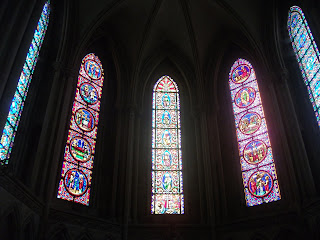
Along the walls were niches, three sided rooms, each dedicated to a saint or soldier, prayer and gratitude, and candles for lighting. Stained glass windows with their rainbow devotions overhead, graves beneath our feet. There was so much to see, so much richness, art, carvings, colors, that it was difficult to know where to look. We circled around, peering into gold lidded boxes beneath glass, containing bits of saints, be they bones or carefully wrapped limbs,


paused to admire and add to a glowing table of candles lit for peace, and lit another candle for Saint Thérèse of Lisieux. I am not Catholic, but there is something deeply spiritual in lighting a candle in such a sacred place, adding a bit of firelight to the world.


I purchased a brochure from the church shop about St. Thérèse, knowing my Grandma would be interested in it, though the proprietress insisted on giving me the Italian version rather than the English one, so convinced was she that I am Italian. No amount of protesting on my part could secure the correct one.


Perhaps it's my sad, sad attempt at a French accent. Sigh.


Or the hair.


Either way, I donated another few euros for the pamphlet in the correct language at the self-serve station out of sight from the nice lady with the strong will, and figured it was all going to a good place.


Beneath the floors of the cathedral also resides the crypt, a place of mystery and the oldest part of the cathedral. It was quite dark down there, actually, only muted light from outside from one and though I hate to use the flash, especially with a nod to not causing light damage, there were no signs prohibiting it and I honestly couldn't see. So I took two photos to get an idea of what was down there. Here's one.


There was something that resonated with some ancient part of my psyche, seeing that angel, being underground with that being, prickled the hairs on my neck. There was power in that ancient face, something awesome in the old, biblical sense of the word.


Can you imagine how a villager, illiterate and full of the fear of God, might have felt in the Middle Ages, passing through the glories of the cathedral and then entering the crypt among the dead?


We missed so much in the cathedral, simply not knowing what to look for and being overwhelmed regardless. We did stumble across the tribute to a Yale boy, from Chicago named A. Peter Dewey who parachuted into France with the OSS in 1944 and then became the first American fatality in Vietnam (then French Indochina) in 1945.


but utterly missed the stained glass window of the patches from all the British units that were in the invasion.


that little person there in the blue would be me, to give you some size perspective

Every time we went anywhere near the Bayeux Cathedral Mike and I were astounded anew by the artistry, the glorious transcendent presence of this holy lady.


Isn't it amazing that there are places like this in the world, that have survived so much, and endure?


I would love for you, if you're interested, to see a little more of these places that I've tried to describe, and to that end, here is a website with some panoramic views that you can navigate, http://www.360cities.net/search/bayeux Here I finally got to see what the crypt actually looks like, much warmer bathed in golden light. I warn you, however, this is one of those websites that you end up clicking "just one more..." and if you go past Bayeux I'm not going to be held responsible if you forget to, say, eat or let the cat out.


Bayeux Cathedral, nighttime