Thursday, November 25, 2010

Send me an angel...


Stained glass window in the famous church in Ste-Mère-Église depicting the Virgin Mary, baby Jesus, and the Paratroopers of D-Day, the village below.

Our second WWII tour in Normandy, the two day "American Experience," was quite a different experience from the first. New guide and new tour members, this time ourselves, a British father and his university age son who were jolly and thoughtful and a husband and wife from the Midwest who made me think, probably unfairly, of American Gothic. The latter were good, honest people, the sort you'd want for neighbors, but not quick enough, mentally, to meet the expectancies of our guide.

He, we could tell at once, was going to be interesting. Maybe good, maybe bad, but definitely interesting. Half French, half American, with either a snobbery issue or inferiority complex, I never did decide. Perhaps that could be traced directly to his heritage. Regardless, it would be entertaining to spend the next two days with him as long as he didn't turn out to be merely annoying.


We were on our guard immediately, as (I am going to call him Travis because while I am going to poke a bit of fun here, and everything is true as I remember it, I would feel terrible if I hurt his feelings) immediately set about being rather bossy and short with the group. The first memorial where we stopped we were told not to read it, as what would be the point of his telling us if we read it and that we needed to stand here, and here, and to not dally and get back into the van and Wendell (from the Midwest) I already answered that question.

Huh. Quite different from our easy-going Alan. Travis then distinguished himself by saying nasty things about how anyone who drove in a way which displeased him must be "tourists" (!) and proceeded to drive rather awfully in a impatient way himself.

I was starting to think I would have to dismiss him, mentally, as an angry little man (little in personality, not necessarily in stature) when he began to speak passionately about a skirmish, and his entire persona changed. He really got into telling the story, with real vim and emotion, making us see it unfold as it had 66 years ago.

Well, alrighty then!


One of the highlights of the day was to stop in the village of Ste-Mère-Église, where the paratrooper Private John Steele's chute so memorably snagged on the steeple of the village church after his group was misdropped, like so many others. Unfortunately for them they came down directly into Ste-Mère-Église.

The town square was well lit that night by a fire burning in a nearby house. Pvt Steele dangled from that steeple for two hours, wounded and having to pretend he was dead while most of his fellow paratroopers were easily killed by the Germans, many of them in the air or not long enough on the ground to have been able to assemble their weapons and defend themselves.


Today, to honor Pvt Steele and the memory of that night, a parachute still flutters from the steeple of the church, now with a paratrooper mannequin dangling beneath.

Now, it must be said that it is on the wrong side of the church, over the square, when Pvt Steele was actually on the other side, (probably a good part of the reason he survived though he made his way down only after being taken prisoner,) but it was adapted as more dramatic that way for the movie The Longest Day.

Who doesn't remember Red Buttons being deafened by the bells and appalled at the massacre being played out around him? I think the French gave a well-practised Gallic shrug and agreed, who are we to argue with such success?

Apparently the previous mannequin was made of wood, and as it aged it deteriorated and eventually fell from the rooftop, scaring the socks off some poor woman who became hysterical, insisting someone had committed suicide off the steeple of the church.

Hopefully the new Pvt John Steele representative will be a little more durable.


Here is Mike next to the very water pump from which the citizens of Ste-Mère-Église filled buckets with water and passed them along a line to try to put out that house fire. Today there is a wonderful Airborne museum where that house stood, including a collection of all sorts of WWII vehicles, a glider, and the Douglas C-47 plane Argonia which pulled gliders and dropped paratroopers on D-Day, marked by the distinctive three white bands on the wings and fuselage that are only seen on aircraft that were part of the invasion.


We also visited Utah Beach, a far, far better place to land than Omaha Beach should you have been an American soldier on that fateful day.

I gathered up a bit of sand. Here I am being a total tourist.
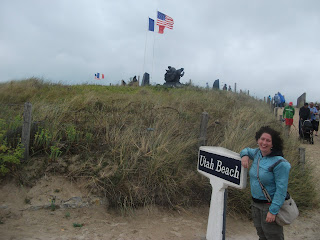


Yes, I am grinning like a moron, but I was having a good time. Note the French and American flags flying side by side.

We learned something interesting passing the town of Isigny. Travis told us that in France you would get a last name, back in the day, by taking the name of that place and putting a d' in front of it. Like d'Isigny, or, as we now know it, Disney. Neat, huh?

Another memorable stop was Saint-Côme-du-Mont, where we stood in the pouring rain to hear the riveting story of 101st Sgt. Joseph ("Jumpin Joe) Beyrle, the luckiest, or perhaps unluckiest, paratrooper of D-Day. He also came down onto the roof of a church. Through a nearly unbelievable series of events, captures, escapes, and misadventures (which you can read about here: http://battlebus.19.forumer.com/a/jumpin-joe-beyrle-saint-cme-du-mont_post126.html ) he ended up being the only known soldier to serve the US and Soviet Armies in WWII, though for the latter he talked his way into a Soviet tank battalion.


Here are the Brits and Mike gleefully (boys!) examining bullet holes in the church cemetery where Sgt. Joe Beyrle first slid down off the roof, jumped over a wall and charged off towards his objective, all the while making as much trouble for the Germans as he possibly could.

When he finally made it back to the United States, Beyrle married his sweetheart in the same church where his Funeral Mass had been held...almost exactly two years before.

I like a story with a happy ending.

This next story is not, one might argue, so noble, but it has been a theme of this blog to boldly describe Going Places I Have Not Gone Before, and on a tour such as this with extended time in the bus, one with a hopelessly tiny bladder like myself has to go whenever the opportunity presents itself.

We pulled into a gravel lot atop a hillside, Travis informing us that there were facilities and that we'd better go if we needed to. Ducking down against the wind and rain he scuttled over to door #1, claiming the closest stall as his own for the time being. No fool I, (again, some might argue this point at which I would have to do my best imitation of a Gallic shrug), I squinched up my face against the weather and made a break for the other option: door #2.

Now, I, and this blog, have gone in some interesting places. But in all our travels, never had I been in this situation.

I was face to face with the solitary plumbing fixture of the room, an elevated urinal.

I glared at the sexist piece of porcelain. Which, frustratingly, didn't do any good. I really had to go. I decided then and there that I had dealt with far, far worse and no stinkin' French urinal was going to get the better of me. Darn it.

Somtimes a woman has got to do what a woman has, well, got to do. But how to go about getting it done? Without getting too graphic, I turned my back, stood on my tippy toes, dropped trou and gave it my best shot.

Would you believe, with the exception of the lack of toilet paper, it was a total success?

I had already half made up my mind to give Travis a hard time for his lack of full disclosure, but when I emerged and peeked into the stall next door which revealed a regular full-service sort of toilet, well, hell hath no fury like a woman...

Gosh, I'm not sure how you would describe my state.

Travis, our funny, finicky guide, was utterly mortified. "I've never actually been in that side!" he protested in horror, verifying the stall's occupant for himself, looking more sheepish than any grown man ought. I let him off the hook at that point. After all, I would never have known what I was capable of had my...comfort zone not been challenged.

We stood on top of that hill and looked into the valley, hearing the tale of the massacred villagers of Graignes, a sad, sad tale indeed, villagers who had risked, and then gave, their lives after they decided as a group to assist the American paratroopers of the 82nd Airborne who had landed nearby, offering them assistance in many ways, including finding and returning equipment bundles that had fallen into swampy areas, hiding the troops, and helping them escape. They were terribly punished for their courage.

Shivering, we retreated to the cold, empty churchyard to hear how the SS had eventually overpowered the Americans with an artillery barrage, and there where we stood they had executed the priest and those who were tending wounded paratroopers, then killed the wounded as well, some where they lay, bayoneting others, and making others dig their own grave before executing them.

As the church steeple had harbored an American sniper who'd made their lives particularly difficult, the SS killed everyone in the church, including two old ladies cowering in their beds. Eventually the Germans ordered all the villagers to leave the town, and shot anyone who argued, then burnt the town, beginning with the bodies of those in the church.

It was a sorrowful place to be. There were other stories, such as that of 15-year-old Joseph Folliot who ferried 21 troopers who had been hidden in a barn by the Rigaul family slowly to safety on his river barge.

But it was our last stop for the day that turned out to be the most memorable.

It was a small place, not in any of the guide books.

On June 6th, 1944, two medics, Private Kenneth Moore and Private Robert Wright of the 2nd Battalion 501st PIR of 101st Airborne established an aid station in the tiny village of Angoville-au-plain, posting signs around a small 11th century church to designate it a field hospital. Neither medic had much medical training, but they set to work doing what they had to do, treating the wounded.

On that day Moore and Wright decided something unusual, something remarkable. They would treat any and all wounded who came to them for help, Allied, German, or civilian. It would not matter which side the patient had fought for. They also agreed they would not allow any weapons inside the church.

For three days the battle continued in and around Angoville, three times Angoville changed hands during the fighting, but the aid station in the church held.

The wounded kept coming.

Moore and Wright worked undaunted under fire in horrible conditions, slipping in the blood of their patients, running back and forth to a well outside the relative protection of the church walls to bring water, tending the soldiers and others laid out head to head on the stone floor and church pews.

At one point a mortar shell came crashing through the ancient ceiling.

The first time the Germans recaptured Angoville they stormed into the church, their guns at the ready. Wright got up from the man he was tending and stood firm in front of them, telling the Germans they would have to lay down their arms if they wished to enter. Seeing both American and German wounded being treated the Germans quietly exited the church, leaving this medical sanctuary alone, and the order was given that the church was not to be bothered again.

In all of that madness, two young medics, boys really, showed what it means to be truly noble.

Eighty men and one child found refuge in their church hospital . The pews are still stained with the blood of the wounded, despite numerous attempts to scrub it out. There is still the mortar mark in the stone floor and bullet scores throughout the church as witness to those days.


Travis, our guide, openly wept as he told us this story. You see, he knew a woman who had lived in the village, 9 months pregnant that June of 1944. She had lived in the family barn with her family while the Germans occupied the house, starving and freezing during the wintertime, and eventually, distrustful but desperate, accepting a ride in a cart from American soldiers and delivering her baby in relative safety away from the fighting.

That baby was Travis' mother.

There are two beautiful stained glass windows in that church in Angoville, in honor of the medics and paratroopers. The first was crafted and donated by an American who had taken the tour and was utterly moved by the story. The second was paid for by the townspeople of the small and poor, but rich in grace, village of Angoville-au-plain.

That night was the night the Brit father and son, Mike and I sat together, far past closing time in a Bayeux restaurant, talking. We went over the day, discussing how what we were learning was affecting us. Thinking back to the stained glass windows of the day, in both the Angoville and Ste-Mère-Église churches, I wondered if the French had seen the paratroopers almost as if they were warrior angels, coming down from heaven to free the people of France.

Sitting at that table after dark, we wondered how we would do the next day, when we would go to Omaha Beach, where so many died, and then the Normandy American Cemetery, where, we felt, none of us would be able to keep it together.


But all of us would be thankful.

Sunday, November 21, 2010

Comin' in on a wing and a prayer...

We had devoted the next three days in Normandy to visiting and learning about WWII related sites in the region. You may ask at this point, why would you spend your vacation on war? Not only that, but you organised your entire vacation around wanting to see these places.


Marmion Farm


We didn't have a relative who fought there, nor was there a particular grave to visit. But we love history. Speaking for myself, I find that war, with all it's horrors and mindlessness, brings out, distills even, the human spirit to it's most essential being, the finest and worst of what we, as humans, can be.

To me, everyday life is apple juice. It's good stuff. But sometimes I guess I want Calvados. It may make you feel giddy with being alive, it may burn going down, it can make you feel terrible.

War stories are the same way.

We entrusted our three days to two tours with a company called Battlebus, a name which gave me pause when Mike first came up with it, but the rave reviews online quickly silenced any misgivings I might have had.

Our guide for the first day was a tall, gregarious and immediately likable Brit named Alan. His job was to take us in the footsteps of the elite American paratroopers of Easy Company of the 506th Regiment, 101st Airborne Division. Perhaps you've heard of them.


screaming eagle symbol of the 101st Airborne


Stephen Ambrose's book, Band of Brothers, wove the story of Easy Company from their training in the States through D-Day, then the Market Garden operation in the Netherlands, Bastogne and the Battle of the Bulge, and all the way to when they took Hitler's Eagle Nest and the end of the war, all as told by the veterans who were there. Then Tom Hanks and Stephen Spielberg (I know you know who those fellows are) made an award-winning 10 part series with HBO and the BBC based on Ambrose's book.

Through the book and then the series, Mike and I had gotten to know some of those soldiers of the 101st Airborne. Know, respect, and admire them; their heroism, their joys and agonies, friendships, grit and resolve.


So, to be able to actually see, to be there in Normandy to hear stories about Winters, Nix, Guarnere, Malarkey, Perconte, Buck, Welsh, Bull, Shifty, Luz, Webster, Toye and Spiers...the list goes on.

Our guide was well up to the challenge. More than. Somewhere between historian and war fanatic, he was utterly excited to share his knowledge with us. Our group of four was bundled nicely into the burgundy and blue Battlebus and we were off.


Dick Winters, along with many others in the 101st, donated his gear (above) to the Dead Man's Corner Museum, St-Côme-du-Mont.

That day we started at a memorial for the C47 aircraft that crashed on D-day, killing all it's occupants including the Easy Company leader, Lt. Thomas Meehan. We also got an idea of why so many of the parachutists drowned, Alan showing us how the fields had been flooded by Rommel. Then Alan took us to the actual crash site of the C47, which he and another WWII enthusiast had found after querying the local farmers and poking around with their metal detectors.

Oh, yes, these grown-up boys go hunting for artifacts, generally with the permission but not always. Alan casually mentioned how they would throw WWII mortars and grenades that they found at one another in moments of irritation or playfulness, and also told us of his friend Sparky who "got whot 'e deserved" when he was shot by a Norman farmer who didn't appreciate intruders digging up his fields and not answering to a warning shout. Not fatally.


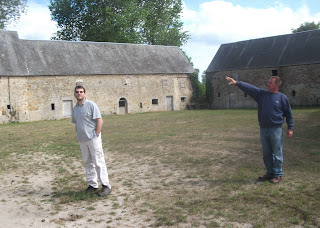
The fantastic thing about Normandy is that nothing changes. The Normans are incredibly practical. They use what they have, don't care about money, rebuild what they lost, and the families that were there in 1944 are more often than not still there, farming their lands. For us, this meant that we could see many things much as they had been in 1944. Like...this wall, riddled with bullet holes.


It was, well it was unbelievable, pulling over on some small road and piling out to hear about where individual men had landed or where Spiers had gone off on a crazy Jeep ride through an utterly taken aback German squadron, then drove back through them, and to Marmion Farm where the Airborne from the 101st and 82nd eventually regrouped and found one another, and many of the more famous photos were taken, like this one by Forrest Guth.


Forrest Guth, who by dint of his name wasn't represented in the HBO series, it was deemed too confusing for viewers, took some wonderful photos of those first crucial days, and later wrote a book of his experiences. Here is Mike in the same spot, note the arched doorway.

Marmion Farm also should have its share of ghosts. During wartime the mother hanged herself on a beam there for some undisclosed reason, and then her husband followed suit, leaving their children orphans. Later a German officer hanged himself on that beam as well. Those children still own the farm, but they are letting it slowly fall apart, refusing to sell the place at well more than its value (offered because of its historical significance) but also not wishing to bulldoze it.


Mike with our WWII guide Alan at Marmion Farm

For the men of the 101st, though, it must have been a place of joy and relief to be reunited with some of their fellow paratroopers, after having been scattered all over the area.

We went to so many sites that day, and heard many, many stories from hair-raising to comic, indescribably sorrowful or horrifying, but the place that was probably the most interesting was Brécourt Manor. Dick Winters had become the acting commanding officer of Easy Company after the loss of Meehan, and he led a thrown together group of 13 Airborne to take out four 105 mm Howitzer cannons, machine guns...and about 60 Germans.

The assault on Brécourt Manor is still taught today at West Point Military Academy as a classic example of tactics and leadership for a small force to overpower a larger one. The Howitzers posed a major threat to the landings at Utah Beach, and had they not been taken out, many more lives would have been lost.


To recreate this legendary battlefield, Stephen Spielberg's team went to ask the DeValavielles if they could measure the fields where the battle took place, to give an accurate portrayal of what happened that day. The Chateau owner gave permission, but on one condition. You see, he'd watched Saving Private Ryan and had a real problem with it. A major mistake had been made, one which must not be repeated.


Brécourt Manor, Le Grand Chemin

The cows were wrong. The brown and white Normande breed, like the hedgerows, can be traced back to the Vikings. Spielberg, who I imagine had to hide a smile, promised to either have the correct brown and white cows imported to be used in the series, or to send cows to makeup. Turned out to be the latter, hopefully Monsieur was pleased.

This is the same family whose young son (who lived to become mayor of Le Grand Chemin) had accidently been shot by one of the Americans. Regardless, they put up a memorial in gratitude to the 101st. Shot, yet still thankful. And take a great deal of pride in their cows.

Very Norman, we were told.

We saw for ourselves what incredible obstacles the hedgerows of Normandy presented to the troops, visited museums and heard about more the Battle of Bloody Gulch, and were generally overwhelmed. The more we heard, the more we realised we'd made a great choice to spend our day with Alan.

Alan told us he was having the best time of his life, giving tours, researching and writing a book. He'd had the usual 9-5 sort of life but left it firmly behind; far from bringing him happiness it had instead given him not one but two mental breakdowns. He mentioned living on 31 cups of coffee a day and cigarettes. Now he lives on a farm in Normandy with innumerable animals, what he described as "an outdoor larder," and his wife and their three children who now speak fluent french and understood exactly where their food comes from.

He asserted with pride that his boys know not to touch the grenades they find without help from their Da to help, even though they're perfectly capable of disarming them themselves.

Right.

At lunchtime we visited the home of one of his cronies, where they had baguettes ready for us, and also all sorts of war memorabilia that had been found in the area. There were containers of metal bits found through years of metal detecting, hopefully not being shot at while doing so. One thing I wanted was a shell casing. I know, I know. But I collect sand, you see.

Another quirk. I have sand from all sorts of places in little matching jars, carefully labelled, and I intended to collect sand from the landing beaches here. How suiting to have a shell casing in with the sand.

I cringe here. Do I sound like a vapid tourist? I hope not. These were beautifully rusted, verdigris shells, old and not going to hurt or defend anyone ever again.

The containers were a bit pricey, and full of all sorts of things. I explained that I didn't really want an entire container (I was already wondering if I could even get a single casing through customs) and could I buy just a casing, or two?

The proprietress looked at me, lowered her voice and said "we don't do this, but..." and let me have my pick of two casings from the containers...as a gift. It turned out to be their last day hosting tours lunches; they were moving back to England.

Perhaps I would be able to get the casings home, perhaps not, but I was touched by her generosity.

Alan told us that he had a vet come on the tour and that it was a real privilege to hear him recall the events of those days, remember his friends and the things that happened so long ago. The veteran, he said, had places he particularly wanted to visit, and he also really wanted one more thing.

A glass of Calvados.

I want to end this Band of Brothers post for you with one last thing, a quote by Dick Winters, a hero in every sense of the word.

"If you can, find that peace within yourself, that peace and quiet and confidence that you can pass on to others, so that they know that you are honest and you are fair and will help them, no matter what, when the chips are down.”

Monday, November 15, 2010

Tell the one about the man who saddled up the wind, pegasus...


Over coffee and croissants at a table alongside a medieval road in Bayeux Mike and I discussed our conundrum: should we spend our one free day in Normandy trying to find Pegasus Bridge?

Opposed: would it really be worth it to go to the trouble and expense of renting a car and braving being lost (pretty much a given) or creamed (possible) on the French roads, just to see, you know, a bridge? I would have to drive. (You may recall that Mike had his license stolen in Athens.) So, while I was nervous about driving, Mike would have to endure much more being the hapless passenger whilst I attempted to navigate an unfamiliar land.

In favor: the tale of the men of the British 6th Division Airborne, glider unit capturing and holding Pegasus Bridge and keeping the Germans from blowing it up to keep it out of the hands of the Allies is our favorite story from D-Day, one told again and again by movie makers and historians, in magnificent works like Cornelius Ryan's The Longest Day and Stephen Ambrose's Pegasus Bridge: June 6 1944.


There's a reason Pegasus Bridge is so well known. It's not only an amazing story, it's also an incredibly important place, historically speaking. This humble spot is the first part of France to be liberated by the allied forces. It's also where the first Allied soldier died on D-Day. Lastly, it's a place where the military plan actually went right, where, had it not, many, many Allied troops would have been lost.

Plus, we wanted to see the dent. Here's a little bit from Ambrose:


The (German) pilot dropped his bomb. It was a direct hit on the bridge tower. But it did not explode. Instead it clanged on the bridge and then dropped into the canal. It was a dud.


The dent is there on the bridge to this day. (British Major John) Howard's comment is "What a bit of luck that was," which says the least of it. Howard adds, with professional approval, "And what a wonderful shot it was by that German pilot."


So when it came down to it, our decision was the price of inconvenience vs. a once-in-a-lifetime experience? Oh please. Like we wouldn't go. I told Mike we had to go. Besides, no one was asking us to get there under the cover of night with fellows firing on us. We could handle it.


Right?


I'd already braved a used book store. It seemed like the correct vacation-in-France ooh la la thing to do. Imagine: the heroine enters the bookstore, pausing just inside the doorway for a moment, the light behind her, appreciating the scent of dust and parchment. She greets the booksellers in quiet French and then selects a tome to enjoy at leisure, to the approval of the clerks there who appreciate her taste.

It was a nice idea, to be sure, but what really happened was this: I circled the shelves in the tiny store until I was helped by the sympathetic storekeepers who, after I admitted a book in English would probably be better for me, (a massive understatement) gently and with great pity showed me the two sparse shelves of applicable paperbacks for those such as myself, tucked away in the back room.

After dithering I picked a couple of classics and while waiting to pay was flirted mercilessly with (or maybe it was at) and then discussed at length about by their other customer, a Norman who had the air of a regular, older, with few teeth but obvious village standing. It was all conducted in mostly-incomprehensible to me French, but when someone is looking directly at you and laughing, well, I suppose I should be happy to have given him entertainment.

Or something.


lovely old doorway, Bayeux


We rented the car. One would think that one line is all that sort of activity warrants in description. Not for us. I had remembered to bring along my international driver's license but not my passport. (Insert mental forehead smack here.)


We'd walked to find the rental place so Mike was generous and and loped back to the hotel to get the necessary papers while I was doing my darndest to make conversation and sign paperwork in a foreign language while praying it had been communicated as to what we did and didn't want. Idle conversation is awkward in one's own language, let alone between two people not versed in each other's native tongue. We ended up renting a four door when all we wanted was two, and once behind the wheel, the manual gears and I had a small disagreement. In other words I ground the heck out of the poor thing, causing the rental car office women to stick their heads out to see what the devil I was doing to their property. I slunk away in vehicular fashion as there was no chance of the situation retaining any sort of dignity for me.


The roads in France were just fine. With it firmly in mind that I had been driving for 2 years in the Middle East, I was neither the best nor the worst driver in France. A minimum of wrong turns later we found the Caen River and went into the museum there, which was phenomenal. If you, like me, enjoy great stories of humanity and courage, and all the lovely sepia remnants of yesteryear, you would have loved it, even without knowing the Pegasus Bridge story.


I'll do my best to tell it in brief, though I encourage you to read Ambroses' version.


flags, crosses and poppies left by relatives and schoolchildren
to remember and honor the men of Pegasus Bridge

The British knew that they had to gain control of the road and bridges on the Caen Canal and Orne River to block the Germans from sending reinforcements down to the landing beaches. They also knew the bridges would be wired for detonation.


The plan was audacious: to send a small group of gliders to silently slip behind enemy lines and land scant hours before dawn on D-day in a field so small the Germans hadn't bothered to plant anti-aircraft posts. The British glider pilots did an amazing job that night, with just the light of the sliver of a moon, landing exactly on target.


Men of the British Airborne Glider and Light Infantry Units

The men, under the command of Major Howard (pictured below), stormed out of the gliders and took the Germans completely by surprise.


It was all over in a matter of minutes. With this crucial victory, D-Day, the turning point of WWII, began.


For Mike and me to go there, to read letters from servicemen to their families back home, see the equipment the men carried and the bits and bobs of combat, was a real treat, history made real.

We even got to admire Bill Millin's bagpipes, the very instrument he famously played to lead what Lord Lovat described as the "greatest invasion in history" while in full Highland rig. Per the rather whimsical orders of Lord Lovat he walked in the traditional way three times back and forth on Sword Beach as the mortars crashed, the sands shook and men died all around him, and then piped the advancing troops up the Caen Canal to relieve the Brit glider squadrons who had taken and held the bridge.

Scottish troops, D-Day

Can you imagine how the men at Pegasus Bridge must have felt, hearing those soaring pipes coming, knowing their relief was nearly there, that they had completely achieved thier objective?

After the war Bill Millin reported that German snipers told him they'd been very aware of him but had been so taken aback by this cheeky Scot and his wailing pipes they'd not shot at him, believing him to be crazy.

Sadly, the bagpipes were a casualty. 3 days after the landings they fell victim to shrapnel, but Bill Millin survived to a ripe old age, and donated those famous pipes to the museum.

We got to walk the original bridge, sold for a sentimental 1 Franc to the museum when it was replaced, and to see the markers placed to show just how precise the pilots had been in putting down the gliders, through barbed wire and avoiding a pond. It was phenomenal.

Mike at the site of the one of the Horsa Glider positions,

reading the tribute at a bust of Major Howard.


There was a strange elation and weariness in being there, which we felt again in the days to come. When one feels this way, the only thing to do is experience it, embrace it, and go to lunch. Which we did across from the first building to be liberated in France, the Café Gondree, now owned by Arlette Gondrée who lived there as a little girl in 1944.

I felt a bit chagrined as an American, a guest in this country, to see "Liberty fries" on the menu, remembering sniggering at (if not endorsing), the idea of changing the name of "French" fries to "freedom" fries during the difficult and emotionally charged days after September 11th.


The French of Normandy have never forgotten the sacrifices made by the Allies. There are roads in the countryside renamed and signed with plaques telling the names of individual soldiers who died there. (we know this because of course we got terribly lost on those little roads on the way back,. thinking we should explore instead of stay on the highway.) They also, I think, remember better than any of us can truly comprehend, what war is.


The bridge was renamed on that day in 1944. Pegasus Bridge in honor of the regiment's symbol.


As Mike and I dined there by the river, watching the new bridge lift up to allow an enormous barge to pass through, we were paying perhaps too much attention to the bridge up in the air. Mike managed to completely miss his mouth with his glass of wine and sloshed a good amount of red down his front. The French couple next to us witnessed this faux pas, their conversation died abruptly, their mouths frozen open and eyes wide. The awkward moment hung in the air.

I snarled at Mike in my broadest and most disdainful fake French accent: "American!"

Eyes crinkled, mouths smoothed into smiles and we all had a good laugh over it, nodding and lifted our glasses to one another in an impromptu sort of toast to life's inanities.

Tuesday, November 9, 2010

Closing time...


If Mike and I were to sit down and design what would be the perfect vacation destination for us, it would have certain factors:

First, it would have to be walkable. We like to meander.

Second, it would have to be beautiful, vistas along with small things for me to photograph, and if it had an interesting history, so much the better.


Third, it would be populated by pleasant, friendly people, perhaps a bit laid back. A place where you could sit on a bench and read a book.


Everywhere in Normandy there are signs and flags that say "welcome to our liberators"


Lastly, and this is important, it would have to have amazing regional cuisine and really wonderful coffee. Fabulous breakfasts wouldn't hurt either, but that's just me.


Oh, my friends, let me tell you: Bayeaux was all that.


I mentioned Mike and I were on a quest for someplace better than McDonalds to eat. This was not, repeat not a problem. I don't think there was a fast food place within 50 miles -when later we drove past the only McDonalds we saw in all of Normandy and Brittany, the guide pointed out the golden arches and proclaimed "the American Embassy."

Oh, those Frenchies and their sense of humor. Ha. Ha ha.

What we found out was that the French come to Normandy for great food. The first thing we discovered, food-wise, was the best ham I've ever eaten. I ordered a Caesar salad at a casual dining spot with moderate prices and service, but when the food arrived it was buried beneath a pile of succulent chunks of roughly chopped smoky pink goodness.


There were the most beautiful breads, and cheeses...


these at a Farmer's Market, and there also was seafood spread out like crown jewels, fish with bright eyes, crabs, and shellfish, all so fresh that a British woman walking towards us actually plucked at my arm, her eyes round, to marvel, even if only with a stranger, "there's absolutely no odour, only the smell of the sea!"


(Asnelles is the name of the village where these mussels were harvested, mussels are called moule)


So when it came time for dinner, we went for, as I'm sure the French would approve of my saying, the gusto and threw price caution to the wind, looking only to indulge our senses.


The worrisome bit of all this was that I was expected to be the one to translate the menus in the all-French restaurants, and my french, well, yeah, I don't claim to speak it. At all. But since I had more than Mike, it worked out that it was my duty, with the result of his eating some very lovely but quite raw (if beautifully prepared) beef thanks to my ignorance.


That evening we were being brave, dining in a restaurant where absolutely not a word of English was available for lame tourists like ourselves. We figured the wine took care of any naughty bacteria. Did I mention the wines? I could rave for another whole post about French wines, but you know, it's been done before.


Also in Bayeux, we discovered Calvados. This is an entertaining sort of golden spirit, an apple brandy that is the specialty of, and only made in, lower Normandy. The French take it quite seriously, as they do with all things aesthetic, and it was my good fortune to be directed by a nice fellow tending bar to try the sample platter and learn about the different grades. The youngest is still aged in oak barrels for two years, up to what must be a fantastically mellow and smooth (not to mention pricey) 20 year old. I can only assume that last bit, they don't offer such in the tasting platter, but the grades I tried went up steeply in quality as they aged.


Quite the thing, I am sure, to take the nip out of a frosty wintry day. Alongside some sort of lovely tripe stew. I hear that's also quite good, but I held back. The translation of the dish stew of “ tripes à la mode de Caen” stomach, guts and foot, made me feel less adventurous, especially after having endured a sort of self-imposed gastronomic tribute above and beyond my personal preferences and cruelty-free general guidelines. I ate, slowly but determinedly, an enormous slab of foie gras.


It was too plentiful, overwhelmingly rich and guilt-inspiring for me to enjoy, but I can see the appeal. Maybe just a little...not a whole duck-worth...on a cracker, perhaps? The French must go through it like gangbusters; there are entire shops that sell nothing else.


Literally everything we ingested in Bayeux was superior, so it was probably our loss when we decided not to try a gésiers salade (salad with chicken gizzards...non, merci) or risk finding out what whelk and periwinkles taste like. (lâches -cowards)


shutter latch, Bayeux


There was one thing, though, that was beyond amazing. An apple pie at a restaurant named Le Pommier. Apple pie may be all-American, but when it is Croustillant aux pommes confites, caramel de cidre et crème glacée (Chef’s special apple pie with cider’s caramel, and spiced ice cream) dessert is an experience above the usual plane of existence. After we practically arm wrestled a new acquaintance of ours into trying it, he took a bite, stopped, and moaned. "My God. This may sound stupid, but this tastes like...Christmas."


Quite a perfect description, actually.


During our time in Bayeux we ate the most amazing meals you can imagine. The Normans are genius with meats and cream sauces, and I seriously considered writing a sonnet to the butter.


Should you ever have the good fortune to visit Bayeux, here's a list of where I would dine should I die and go to heaven:


Le Pommier -warm, elegant service and the most delicious apple pie in the universe. The second time we ate there, there were no inside places but, undeterred and desperate for one more taste of that pie we took a table outside and shoved our table next to the wall, just out of the pouring rain, fending off the cold with potent cups of coffee.


La Rapiere -have reservations or they will regretfully turn you away. Family owned restaurant, absolutely delightful service of several generations of Norman women.


Le P'tit Resto -innovative cuisine and only French spoken here. Be brave, you will be rewarded. In the shadow of the cathedral. We ended our meal listening to medieval chants being sung nearby by a woman with a poignant contralto.


Le Bout en Train -this one needs a bit extra for its write up. We had walked past it several times and given it the eye. First of all, it was very sleek and modern looking, not at all in line with the classic, old world feel of the rest of the village. Then...the logo and much of the decor was pink. Hot pink and rose pink. And...no one ever seemed to be eating there. We gave it pity and kept walking.


That is, until one of our guides (the same one who pointed out the American Embassy) told us that his good friend is the chef. I had blurted something along the lines of "oh, yeah, that's the pink place that has no customers..." when he initially described the place, which made his face fall. Karmically we owed it a try.


The meal was up to the standards of the town, the tender duck, creamy turbot and succulent herbed pork all fantastic, with Moelleux au chocolat (chocolate cake) that was out of this world, but what really stood out to us, was that although we lingered until nearly 2 am on a weekday over wine, talking, relaxing and laughing, the restaurant had actually closed at 11.


Being French, the staff had never even hinted that we should leave, and stayed, smoking and tidying up discretely.

Graciously allowing guests to enjoy their evening far beyond closing time, well, it was very French. One may be rude, snobbish even, but paramount is the enjoyment of good food, wine, and conversation.


What a lovely country.

Thursday, November 4, 2010

Just in time, I'm so glad you have a one track mind like me...

In Amsterdam Mike and I boarded a train heading south, pausing in the cities, Rotterdam, Antwerp and Brussels, and speeding through the forests and countryside of the Netherlands, Belgium and France, arriving about 3 1/2 hours later in Paris.


Paris was a mess. The trains were running late, the station was overflowing with travellers, some in lines looking disgruntled or resigned, others sitting forlornly on the floor with their luggage and pets and children.

There was a lot of French in the air, punctuated now and then by the Thalys theme, (dum duddy DAH-da,) which always put me in mind of Britney Spears' "Crazy". This was a little bit annoying as I couldn't recall any of the lyrics to that bit of pop drivel.

However, I figured that when one is in Paris, being slightly annoyed with something largely imperceptible to anyone else is going with the flow...as long as you look good doing it.

We decided we would get our tickets and move on, getting away from the inexplicable masses. (We never did figure out what was going on that day!) Mike was fussing about finding and going through customs. Which...were nowhere to be found.

I decided that if the French had wanted us to go through them, they would have made such obvious to even the most dense tourist. Perhaps with the event of the EU, security laden border crossings have become a thing of the past? Welcome to the new Europe.

We went on Paris' excellent and nearly foolproof Metro to find the station where we would pick up our next train. There was just enough time to grab a quick meal, and here I hang my head with shame that our first meal together in Paris was at...McDonalds.

Oh, the shame, the shame. (Then again, french fries in France...salty, hot and tasty...) It was also the most sterile meal I have ever ordered. We used an automatic machine to place our orders and to take our credit card, and picked up the finished product at the counter. I don't think we actually interacted with a real live human being for any of the process.

They weren't pommes frites in paper cones, but it did the job. I felt so damnably American, though. I kept hearing Red Buttons as Pvt. John Steele in The Longest Day: "Je suis American, je suis American".

Onto the next train, where we learned how it works on the trains: if you don't have a seat number on your ticket you might be able to snag one, but more likely, like us, you will be out of luck. They'll let you ride, but you have to find someplace to wait out the trip that's out of the way, and if there's no dining car, you'll probably end up, again like us, in the noisy luggage area between the cars.

We hunkered down with our luggage and an experienced traveller who'd brought a baguette -no McDonalds for him. With some squirming around we found a spot that was mostly out of the blast zone -the opening and closing doors let in the roar of the train- in a niche where no one would step on us and we could brace our knees to stay relatively stationary. Tuning out on headphones to non-Britney Spears music, well, we were good to go.


Mostly.


But it didn't matter! We were on vacation, on vacation in France, and going to the place around which we'd set the rest of our trip: Normandy. The train was taking us, moment by moment, towards Caen and Cherbourg, the landing beaches of D-Day, St-Mère-Église, places we'd long envisioned while learning about the second World War.

It was hard to believe we were really going there.

I demonstrated my excitement by taking half a nap. I'm like a little kid that way.

Mike had done exhaustive research on train travel, towns, tours, and B&Bs for us. Impressive, considering he was also wrapping up his work in Dubai, closing down the house, and dealing with his wife. (Yes, he only has one. I should think that would be more than enough, wouldn't you say?) Thanks to his efforts we'd decided to stay in the small but history-rich town of Bayeux, whose name we couldn't quite pronounce. (Bay-oo? Bye-uh? Beeh-you? Criminey.)

Finally, our carefully-chosen destination. We stretched kinked limbs, emerged into the sunshine, and began to hike towards the spires of the unmistakable Notre-Dame de Bayeux, a Norman Romanesque cathedral; according to the map our B&B was nearby.

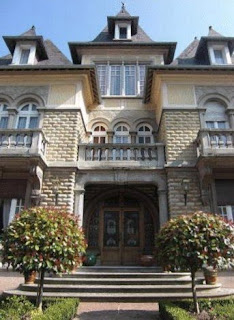
When we got to our new home, Le Castel Nobel, I turned to Mike and said, oh, wow.

(photo from Le Castel Nobel Guesthouse website)


We spent less time than we might have admiring the outside of our new residence, being eager to drop off our luggage. Mike had warned me that the reviews of Le Castel Nobel had been stellar with the caveat that the hostess spoke no English.


We found this to be true. Which was fine, we were in France, after all. She spoke twice as much French to make up for our lack, utterly undeterred by the looks of confusion. Our responses were limited to oui, (yes) non,(no) and Je ne sais pas, which I thought translates as "I don't understand" but what actually means "I don't know."

Making absolutely sure we understood how to let ourselves in with the key, demonstrating several times (as non-French speakers we were in the category of obviously stupid but worthy of pity and compassion) our hostess finally showed us up a beautiful staircase to our room.

She never stopped talking. We were smothered in motherly French.


Upon entering our room, and escaping le déluge, I did a slow 360 and said once again, oh wow, Mike!


Luxurious, with a balcony one one side and a charming little alcove for reading looking over the gardens on the other, lovely bathroom with all the trimmings, elegantly decorated, and this was the view out our leaded-glass windows:


Mike did good. We headed out, giddy as kids, to explore a medieval French village that had been spared the bombings, the great Cathedral amongst the wood and stone houses on narrow cobblestone streets, and the River Aure.


And to find something better to eat than McDonalds.